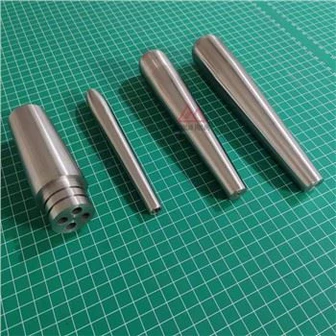
Performance comparison of crucibles for OLED evaporation: tantalum, graphite, boron nitride
OLED technology refers to the phenomenon in which organic semiconductor materials and light-emitting materials are driven by an electric field to emit light through carrier injection and recombination. As a solid-state self-luminous technology, OLED does not require the combination of LCD and LED backlight before, so the thickness of the TV can be made very thin, the viewing angle is wider, the power consumption is lower, the color is richer, and it can be used in It is produced on different flexible substrate materials such as plastics and resins to realize soft screens, so it is more and more popular among consumers.
In the manufacturing process of OLED, "evaporation" is the essence and the difficulty. It means that under high vacuum conditions, the material to be evaporated is heated by resistance or electron beam, and the OLED material is heated by a crucible in the vacuum chamber. A coating technique in which atoms evaporate, reach and attach to the surface of a substrate.
In OLED, in addition to luminescent materials, even metal electrodes are evaporated in this way, so the quality of the crucible directly affects the yield of the OLED process. If you choose an unsuitable crucible, the material in the crucible will not be fully evaporated, the boiling point required by the equipment will not be reached, and it will not be able to adhere to the surface of the substrate, which will not only waste time and manpower, but also cause the evaporation material to be ineffective , The process yield deteriorates, increasing the burden of raw material costs. So choosing a good crucible is a good start.
Material selection of crucible for OLED evaporation
Commonly used supports are: W, Mo, Ta, high temperature resistant metal oxides, ceramics or graphite crucibles, etc. However, it should be noted that there may be a reaction between the support material and the vaporizer. At present, OLED evaporation materials are mainly organic and metal, and the following three kinds of crucibles can be used.
1 Tantalum (Ta)
Tantalum is a hard blue-gray rare transition metal. It has high ductility, high chemical stability, and does not react with other compounds. Its melting point is as high as 2996°C, and it mainly exists in tantalite. Tantalum has moderate hardness and ductility, and can be drawn into filaments to make thin foils. Its thermal expansion coefficient is small. Tantalum has very good chemical properties and is extremely resistant to corrosion. It does not react to hydrochloric acid, concentrated nitric acid and "aqua regia" under both cold and hot conditions.
Tantalum can be used to make evaporating vessels, etc. It can also be used as electrodes for electronic tubes, rectifiers, and electrolytic capacitors. It is also often used as a secondary component of alloys. The corrosion resistance of tantalum mainly comes from the stable tantalum pentoxide (Ta2O5) protective film formed on its surface, which can well resist oxidation, so it can be used as a crucible material for vacuum evaporation parts. Tantalum is required for many corrosion-resistant parts.
2 Special graphite (Graphite)
Graphite is a crystalline form of carbon. Colors range from deep black, iron ink to dark gray. Melting point 3652 ℃, boiling point 4827 ℃. Soft, smooth surface, conductive, chemically inactive, not easy to react with acids and alkalis, etc., and are often used to make crucibles. It is the most suitable crucible for melting various types of alloys in small quantities. High temperature performance and long service life, and are used in large-scale alloy smelting casting process and ore melting analysis. At the same time, the graphite crucible has good liquid and gas impermeability, can withstand high temperature, and inhibit the generation of dust.
However, since graphite crucibles are basically under high temperature conditions and there is a lot of air around, they are easily oxidized. Moreover, in the process of smelting, casting and melting, the graphite crucible will be severely corroded, reducing its service life. In order to improve the service life of the graphite crucible, materials such as silicon carbide can also be added to the graphite crucible to enhance its corrosion resistance.
3 Pyrolytic Boron Nitride (PBN)
Pyrolytic boron nitride (PBN) is an advanced ceramic material of hexagonal crystal system. It is ivory white, non-toxic, with a purity of 99.999%, acid and alkali resistance, oxidation resistance, good thermal conductivity, good surface density, high temperature resistance, No porosity, easy to process. It is produced by chemical vapor deposition method under the condition of high temperature and high vacuum, using boron-containing gas (BCl3 or B2H6) as raw material. However, because B2H6 is highly toxic, BCl3 is currently used as raw material. Among them, the boron-containing gas reacts with NH3 through pyrolysis (1500~1800℃) in a high temperature reaction chamber to form boron nitride solid.
The growth process of PBN material is similar to "falling snow", that is, the small hexagonal BN snow flakes grown in the reaction are continuously piled up on the heated graphite matrix (mandrel), and with the extension of time, the accumulation layer is thickening, that is, the formation of After the shell of the PBN is removed, it is an independent, pure PBN part when it is removed from the mold, and the PBN coating is left on it. The same method can also be used to prepare PBN sheets.
The high purity of PBN crucible is because its preparation process does not need to add any sintering agent, so the operating temperature under vacuum is as high as 1800 degrees, and the maximum temperature under atmosphere protection can reach 2100 degrees (usually nitrogen or argon). It is most used for plating/molecular beam epitaxy (MBE)/GaAs crystal growth. However, due to the slow deposition rate, PBN crucibles are quite expensive, and most of them are small-sized crucibles.
How to choose?
Of course, it is necessary to proceed from the actual situation, and then choose according to the requirements of the production process. For example, different evaporation materials can be matched with different crucibles, because not all crucibles can be matched to the boiling point required by the material. the purpose of evaporation. In addition, the density and thermal conductivity of the crucible material are also determined according to the actual production situation. Therefore, crucibles for OLED evaporation generally need to be customized to achieve good results.