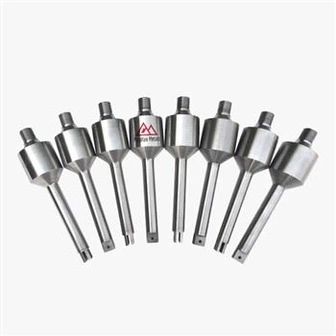
Tungsten nickel copper alloy material introduction
Nickel-copper alloy is made of tungsten matrix with a small amount of nickel, copper and other alloy elements. It has the following characteristics: non-magnetic, high density (~18.8g/cm3) and adjustable, high absorption of high-energy rays (ray absorption coefficient is 1/3 higher than lead), low thermal expansion coefficient (4~6×10⁻⁶/℃), machining, welding and so on. It is widely used in the field of ray shield protection sensitive to magnetic environment.
Material performance
- Non-magnetic;
-- specific weight: ~18.8g/cm3 high density;
- High strength: tensile strength of 600-900mpa;
-- Strong ray shielding ability: under the condition of the same thickness, the ray shielding ability of tungsten alloy is 1.7 times more than that of lead. When the ray is stronger, the difference between the two is more obvious.
-- High thermal conductivity: the thermal conductivity of tungsten alloy is 5 times that of die steel;
-- Small thermal expansion coefficient: the thermal expansion coefficient of tungsten 4~6×10⁻⁶/℃, only 1/2-1/3 of iron or steel;
- Good plasticity, workability and weldable;
Compared with lead, tungsten alloy material has environmental protection characteristics, so it is not harmful to human safety when making radiation detectors with tungsten alloy shielding parts;
Compared with tungsten-nickel-iron alloy, it has its unique advantage of anti-interference in the field sensitive to magnetic environment.
The product application
Radiation protection and guide: because of its high density (18.8 g/cm3), as well as excellent x-rays, gamma ray absorption ability, good workability, nonmagnetic, makes our production of tungsten nickel copper alloy are widely used in the magnetic environment sensitive areas of radiation shielding protection, etc., of course, we not only provide raw materials and finish machining parts.
Production process
Using powder metallurgy process, in strict accordance with ISO 9001 quality standards to complete the production of tungsten nickel-copper alloy in each stage, the products fully meet the specifications and requirements of AMS-T-21014 and ASTM-B-777-99 (MIL-T-21014).
Using ISOstatic PRESSING technology can produce a variety of high specific gravity alloy large, special-shaped parts, using extrusion, molding, injection forming technology can produce a variety of small products, using forging, extrusion, rolling technology can produce a variety of processed plate, bar and other parts, can provide users at home and abroad with a variety of high density alloy.
For general applications, such as radiation shielding devices, sintered alloys are used directly; However, for applications requiring high mechanical properties, tungsten-nickel-copper alloys need to be deformed and quenched to strengthen.