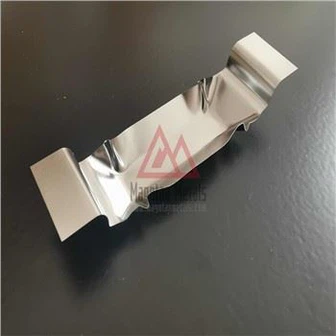
What are the difficulties encountered in the production of tungsten machined parts?
Tungsten is a rare metal that is known for its remarkable strength, durability, and resistance to corrosion. It is widely used in various industries to make tools, machinery, and electronic components. However, tungsten processing parts also have their own set of challenges in the processing stage. In this essay, we will explore the difficulties faced by tungsten processing parts in processing, along with some measures to overcome these challenges.
First and foremost, tungsten is an extremely hard and brittle metal, which makes it difficult to machine. When tungsten is cut or drilled, it tends to crack or break due to its inherent brittleness. Additionally, tungsten has a high melting point, and it is not easily malleable when compared to other metals. This makes it tough to shape and mold into the desired form, requiring high machining forces, which increases the wear on the cutting tools.
Another difficulty that arises during processing tungsten is that it is highly reactive with oxygen and other elements in the atmosphere. This makes it challenging to work with, as it needs to be processed in a vacuum or under an inert atmosphere like argon to prevent oxidation from occurring. This requires specialized processing equipment, which adds to the cost of production.
In addition to the above challenges, tungsten processing parts also face difficulties in surface finishing. It is challenging to maintain the desired shape and surface finish of tungsten parts due to its brittleness and hardness. The surface roughness of tungsten parts tends to be high, making it challenging to achieve the desired tolerances and surface smoothness.
Furthermore, tungsten has poor thermal conductivity properties, which causes it to overheat quickly during processing. This can lead to tool wear and breakage, as well as damage to the tungsten part itself. Additionally, tungsten has unique cutting properties, which require special machining strategies and tool geometries.
Despite these challenges, there are ways to overcome them and ensure effective processing of tungsten parts. One of the most common methods is to use a diamond tool for machining tungsten, as diamond is the hardest known material and can handle the wear and tear of processing metals like tungsten. Furthermore, the use of a coolant can help to dissipate heat and prolong cutting tool life. Specialized coolants such as water-soluble oils are used to aid in machining tungsten and other hard metals.
To prevent oxidation from occurring during processing, the use of specialized processing equipment like vacuum chambers or inert gas environments such as argon can be employed. This serves to keep oxygen and other reactive elements away from the tungsten, ensuring that it stays pure and free from contamination.
In conclusion, tungsten processing parts face various challenges, from their inherent brittleness to their high reactivity with atmospheric conditions. However, with specialized equipment and machining techniques, these challenges can be overcome. Furthermore, tungsten is a valuable material with exceptional properties that make it highly sought after in many industries. Therefore, it is crucial to continue exploring new methods to efficiently process this metal while improving its performance and usability in various applications.