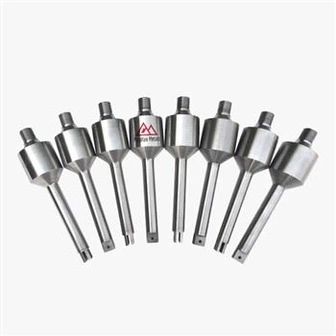
Brief analysis of tungsten-nickel-copper alloy
By definition, tungsten-nickel-copper alloy is an alloy consisting of tungsten matrix and adding a small amount of nickel, copper and other chemical elements. The English name is Tungsten nickel copper alloy. The ratio of nickel to copper in common alloys is generally 3:2.
From the physical and chemical properties, it has no magnetism, no radioactivity, environmental protection, high specific gravity (16.5 ~ 18.75g/cm3), high tensile strength (700 ~ 1000MPa), high thermal conductivity (5 times of die steel), low thermal expansion coefficient (only 1/2 ~ 1/3 of iron or steel), strong ray shielding ability, Good electrical conductivity, weldability and machinability.
Note: Compared with tungsten-Ni-Fe alloy, because copper does not have the effect of nickel and iron to activate tungsten sintering, W-Ni-Cu alloy has lower sintering density, poor strength and plasticity, and generally can not be heat treated and deformed.
From the perspective of production technology, the production steps include: firstly, tungsten oxide, nickel oxide and copper oxide powder are evenly mixed, and then the mixed raw materials are reduced to get tungsten, nickel and copper mixed powder, and then pressed into billet, and finally sintering, cooling to room temperature, to get the required products.
From the point of view of use, the first is can be used as shielding material, has a good absorption effect of X-ray and gamma rays, and is suitable for the magnetic environment sensitive ray shielding field; Second, it is used as a high-voltage electrical switch contact and electrode for electrical processing, which is mainly due to the strong conductive ability and good high temperature resistance of the alloy; Three is for gyroscope rotor and some need to work in the magnetic field environment of the equipment parts, because it is good antimagnetism; Four is to make a variety of counterweights.