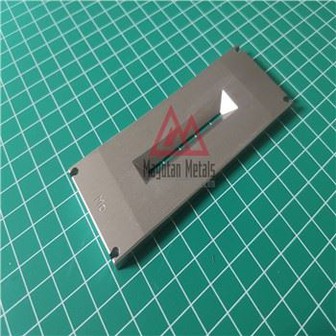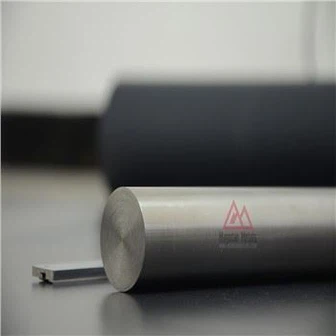
Brief analysis of tungsten-nickel-iron alloy
Tungsten-nickel-iron alloy can be simply understood as an alloy with tungsten as the main raw material and nickel, iron and copper as auxiliary raw materials. The ratio of nickel-iron added is generally 7:3 or 1:1, which is called Ferro-tungsten-nickel alloy in English.
The properties of tungsten-nickel-iron alloy
Tungsten-nickel-iron alloy has higher density (16.5-18.75g/cm3), greater strength (tensile strength of 700-1000Mpa), greater thermal conductivity (5 times of die steel), smaller linear expansion coefficient (only iron or steel 1/2-1/3), better electrical conductivity and plasticity, Excellent weldability and machining performance, etc.
The difference between high nickel-iron ratio tungsten alloy and traditional nickel-iron ratio tungsten alloy is as follows: the mechanical properties of the former alloy are much lower than those of the latter under slow cooling condition after sintering, which is mainly due to the serious precipitation of non-dispersed-β phase in the bonding phase of the former and at the interface between the tungsten and the bonding phase under this condition, which further reduces the mechanical properties. Under the condition of solution quenching, the comprehensive mechanical properties of the former are far better than those of the latter, which is mainly because the strength and toughness of the high Ni-Fe ratio tungsten alloy increase with the increase of the Ni-Fe ratio. When the Ni-Fe ratio is about 9/1, the mechanical properties of the alloy reach the maximum value.
Preparation method of tungsten-nickel-iron alloy
Raw materials: ammonium tungstate, nickel nitrate, ferric nitrate, concentrated nitric acid, etc.
Preparation process: (1) the mixed solution of dispersant and ammonia water is added to the ammonium tungstate solution under stirring condition; (2) ferric nitrate and nickel nitrate were added to the solution and stirred evenly, heated in a water bath at 60℃ for 10 minutes, and then concentrated nitric acid was added for chemical co-precipitation reaction; (3) At the end of the reaction, the precipitate was calcined in a drying box at 250℃ for about 2 hours to get the composite oxide powder; (4) the composite powder was ground in a mortar and sieved with a 200-mesh sieve. The sieved powder was placed in a strong drainage and ventilation furnace for low temperature reduction (650℃ -750 ℃) to obtain tungsten-nickel-iron composite powder. (5) the composite powder was pressed with a steel mold under the pressure of 360MPa to get the embryo; (6) the embryo was sintered in oxygen furnace at 1150℃ -- 1350℃ for 2h, then the final product was made.
Application of tungsten-nickel-iron alloy
With excellent physical and chemical properties, tungsten-nickel-iron alloy is widely used in information, energy, metallurgy, aviation, aerospace, national defense and nuclear industry and other fields. The products mainly include counterweight, balance hammer, radiation shield, gyroscope rotor, armor-piercing bullet core, switch contact and so on.