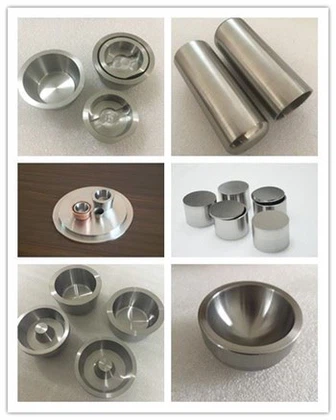
Cutting technology of tungsten material
High melting point metals commonly used in industry are collectively referred to as refractory metals, such as tungsten, molybdenum, tantalum, niobium, zirconium and so on. With the development of science and technology, refractory metals have been more and more widely used in atomic energy, aerospace, machinery, electronics, chemical, medical, textile, light industry and so on. Refractory metal has high melting point, high density, stable crystal structure and high activation energy, but it is difficult to cut. Refractory metal material is mainly composed of refractory metal and other alloying elements are added. Among common refractory metals, tungsten has the highest melting point (3410℃), high density (19.35g/cm3) and high elastic modulus of molybdenum.
Tungsten alloy sintered by powder metallurgy with cobalt and nickel as binders has a high density, known as high density alloy, also known as high specific gravity alloy. The density and strength of such alloys can be increased by forging or heat treatment. Tungsten alloys usually have tensile strength of 980MPa and hardness of 40HRC. The thermal conductivity of tungsten alloy is smaller than that of pure tungsten, the chip is granular, the tool-chip contact length is short, the cutting temperature is very high, and it is easy to produce nodules and bond wear. Cutting tungsten alloy requires the tool material good thermal conductivity, high bending strength and toughness, good hardness. It is recommended to choose the tungsten carbide base fine grain ultra-fine grain hard alloy. When cutting tungsten alloy, the cutting tool should be sharp and the edge strength should be guaranteed.
How to improve the machinability of tungsten?
The machinability of tungsten is very poor. In order to improve the machining efficiency and quality, the following methods can be adopted to improve the machinability of tungsten:
(1) There is a hard oxide layer on the surface of tungsten billet, which will aggravate the tool wear or produce the phenomenon of "cutting" during processing. Therefore, before processing, the tungsten blank can be sandblasted to remove the surface oxide layer and reduce tool wear.
(2) The transition temperature of metal from plasticity to brittleness is called plastic-brittleness transition temperature. The plastic brittleness transition temperature of pure tungsten is very high. In order to improve its machinability, the workpiece can be heated to more than 200℃ by blowtorch before cutting.
(3) Copper carping can also improve the machinability of tungsten. The turning condition of blunt tungsten after copper plating is similar to that of No. 45 steel.
(4) Adding some zirconia to tungsten can also improve the machinability.